Activewear Product Photography: The Complete Guide for Sports and Fitness Brands (2026)
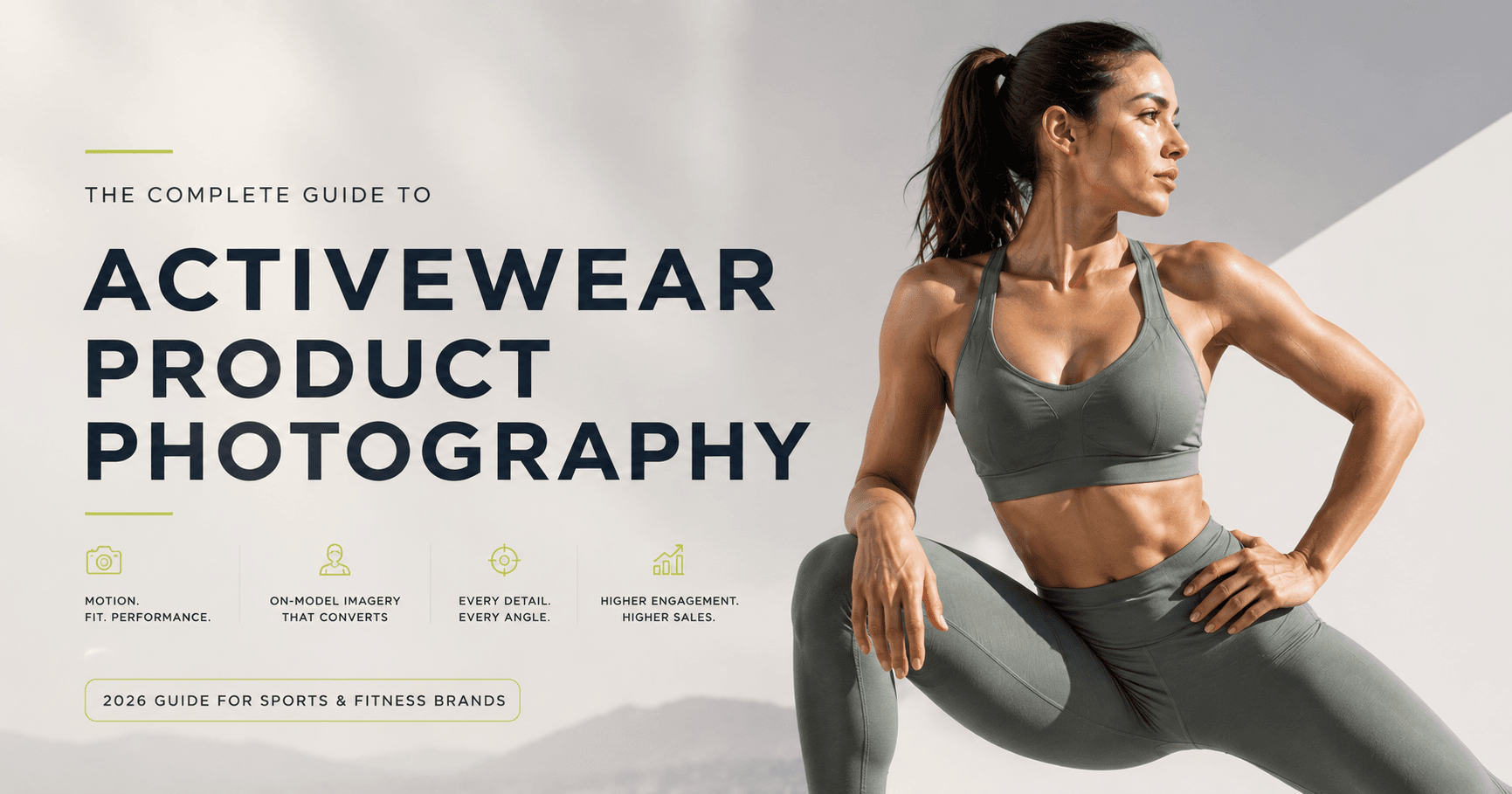
Activewear is one of the fastest-growing fashion ecommerce categories globally — and one of the most photographically demanding. Unlike a dress or a shirt, which can be photographed front-on and communicate most of what a buyer needs to know, activewear must be shown in use. The model's position is product information. A squat tells the buyer the leggings are designed for gym use and shows how they perform under load. A stride tells the buyer the shorts are designed for running and shows how they move with the body. A plank position tells the buyer the sports bra is built for high-intensity use and shows how the back straps and support structure perform during exercise.
The challenge for most activewear sellers — from independent gym wear brands launching their first collection to established sportswear companies expanding their SKU range — is that performance-context photography traditionally required fitness models, gym environment access, specific lighting equipment for high-motion shooting, and significantly higher post-production investment than standard fashion photography.
FEATURED SNIPPET
What is the best way to photograph activewear for ecommerce?
The most effective activewear photography for ecommerce combines a white-background primary image (required for most marketplaces) with performance-context secondary images showing the garment on a model in activity-appropriate positions. For leggings: squat position to show opacity and construction under load. For sports bras: plank or arms-extended position. For running shorts: stride position. Essential additional images include back view, waistband or strap close-up, fabric texture macro, stretch demonstration, and a lifestyle image in a relevant exercise environment. AI photography tools like Studiofy generate performance-context model images from a static product photo, removing the need to hire fitness models or book gym environments.
Studiofy At a Glance
Why Activewear Photography Is Uniquely Demanding
The ecommerce activewear market reached over $400 billion globally in 2025 and is projected to continue at strong growth rates through 2030. The category's expansion is driven by both athleisure normalisation — activewear worn as everyday casual wear — and genuine fitness market growth. This means activewear photography must now serve two distinct buyer audiences simultaneously: performance-focused buyers evaluating functional features, and lifestyle buyers evaluating aesthetic and social appropriateness.
Fabric-Specific Lighting for Activewear Materials
Nylon, Polyester, and Spandex Blends
Most activewear is made from synthetic fabric blends — typically nylon-spandex, polyester-spandex, or nylon-polyester-spandex combinations. These fabrics are semi-reflective. A large, fully diffused softbox at 45 degrees is the standard setup. The size matters: a 60x90cm softbox is the minimum; larger produces better results.
Mesh and Ventilation Panels
Many activewear garments incorporate mesh panels for ventilation — across the back of sports bras, along the side seams of leggings, on the shoulders of running vests. Mesh is a distinct visual element that communicates breathability and construction quality. Position your light so it can pass through the mesh structure and create the depth contrast that makes mesh visible and readable.
Compression Fabrics
Compression fabric opacity under pressure is one of the most searched activewear attributes. A squat position photograph has become the standard industry demonstration image because it shows the fabric at maximum tension — the point where inferior compression fabrics fail opacity. Include this image in every compression legging listing.
Reflective and Technical Performance Materials
High-visibility running gear, reflective cycling jackets, and technical outdoor performance garments have specific material features — reflective coatings, waterproof membranes, DWR finishes — that must be demonstrated visually. Include a dedicated feature demonstration image for each performance material property that drives purchase decisions.
The Complete Activewear Image Set by Category
Platform-Specific Requirements for Activewear Sellers
Amazon — Pure white background (RGB 255,255,255) required for primary image, 85% frame fill, 2000x2000px minimum recommended. Secondary images: model photography strongly recommended and supported. A+ content for brand-registered sellers significantly improves conversion.
Myntra — On-model imagery is required as primary for most apparel categories. Myntra's design-led positioning means image quality expectations are higher than average. Lifestyle-quality model photography significantly outperforms basic catalog imagery.
Flipkart — White background required, model images recommended, portrait format preferred, 7-8 images strongly recommended for full category competition.
Zalando — On-model photography is required for most activewear categories on Zalando. The platform's strict quality guidelines make AI-generated on-model imagery a practical solution for brands without access to European-standard photography infrastructure.
Shopify — No technical restrictions. Activewear brand stores typically use editorial-quality performance model photography as the brand identity foundation. AI lifestyle photography allows this level of brand positioning without editorial shoot budgets.
Common Activewear Photography Mistakes
Using a flat lay as the primary image — A flat lay legging communicates colour and very rough shape. It says nothing about compression, construction quality, waistband width, opacity under use, or how the garment fits a body. Flat lay photography as the primary image for performance apparel is the fastest way to lose the click to a competitor with on-model imagery.
Static model poses for performance garments — A model standing straight-on in compression leggings tells a buyer almost nothing beyond colour and rough fit. The position must communicate the product's intended use. A squat, a lunge, a stride, a plank — these positions make the image a performance statement.
Not demonstrating key technical features — If your leggings have a phone pocket, show it with a phone in it. If your running jacket has sealed seams, show a close-up of the seam construction. If your running gear has reflective elements, include a reflectivity demo image.
Ring lights for synthetic fabric — Ring lights create circular reflections in synthetic activewear fabrics that make the material look cheap and over-processed. Use large diffused sources — softboxes or window light — for any synthetic fabric garment.
How AI Photography Solves Activewear's Biggest Visual Commerce Challenge
The core challenge of activewear photography is that the images buyers most need — performance-context model shots in gym environments, outdoor running settings, yoga studio aesthetics — are the images that cost the most to produce through traditional photography. Fitness models, gym location access, higher-energy lighting setups, and more demanding post-production all add to the per-image cost significantly versus standard fashion photography.
Studiofy generates photorealistic on-model images of your activewear in performance-appropriate contexts from a single product photograph. Upload a flat lay or hanger shot of your leggings; Studiofy generates a model in a squat position in a gym environment. Upload your sports bra; Studiofy generates a plank position image with a fitness studio background. The same workflow applies for every activewear category, every performance context, and every market aesthetic.
How to Photograph Activewear for Ecommerce: Step by Step
Prepare the garment
Wash and dry the activewear to remove any packaging creases. For leggings and compression garments, ensure the waistband lies flat and any logo or design is clearly visible.
Set up large diffused lighting
Use a large softbox (minimum 60x90cm) at 45 degrees or a large north-facing window. Diffusion is critical for synthetic fabrics — undiffused light creates harsh surface reflections.
Photograph the required angles
White background front: waistband, seam structure, and full length visible. Active pose: squat for leggings, plank for sports bras, overhead for shorts. Back view. Fabric close-up. Stretch demonstration.
Generate performance-context AI model images
Upload your activewear product photo to Studiofy. Select performance-appropriate model pose and gym or outdoor setting.
Complete the image set
Build the complete per-listing image set: white background primary, active model pose, back view, waistband/strap close-up, fabric texture, stretch demo, lifestyle, size guide. Use all available slots.