How to Photograph Clothes Without a Model: Every Technique Compared (2026)
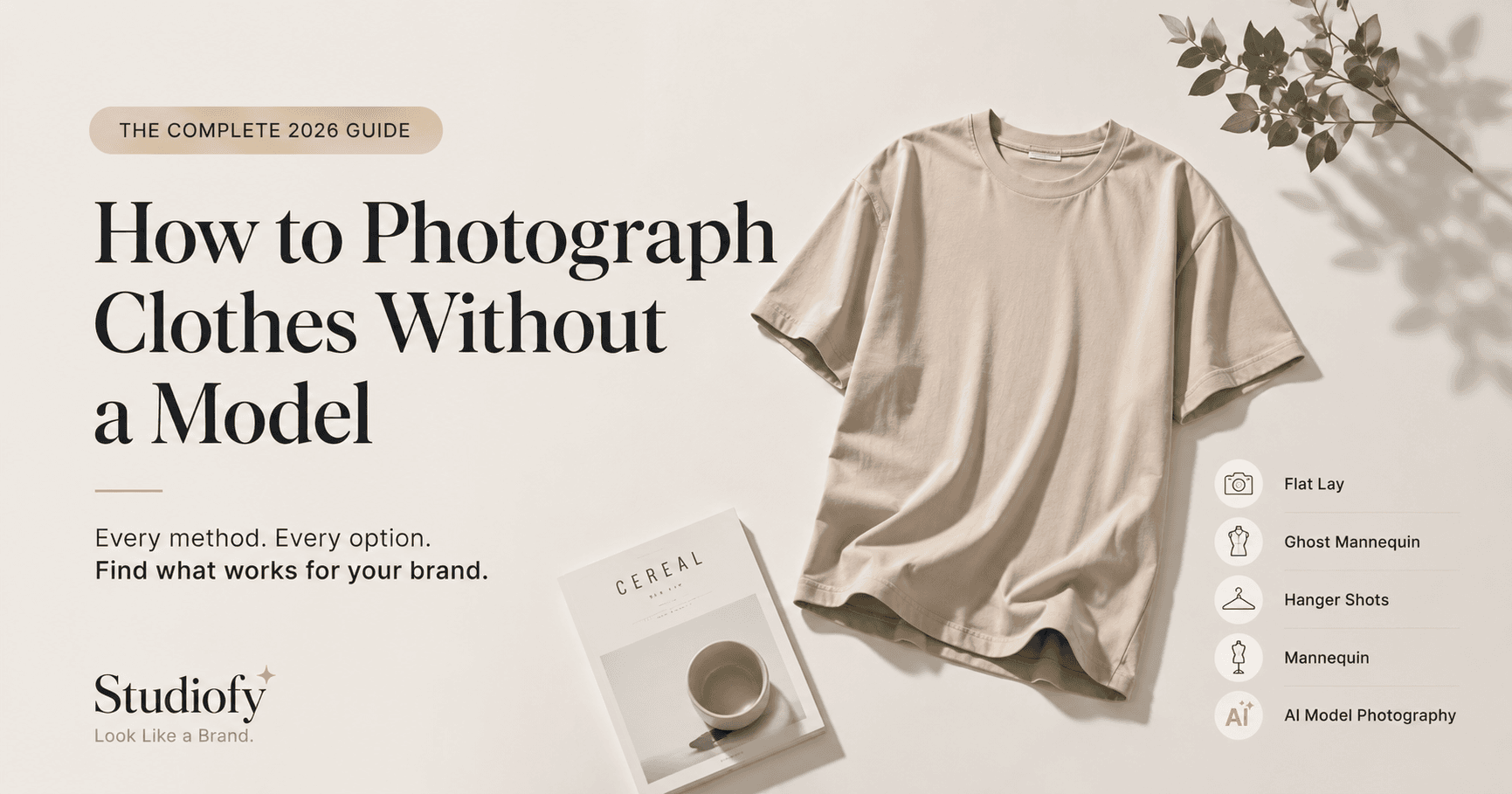
The majority of fashion ecommerce sellers globally don't have access to professional models. The costs — model fees, photographer, studio, styling, hair and makeup — are prohibitive for most individual sellers, small brands, and businesses in the early stages of building an online catalog. Yet on-model imagery is the image type that most directly drives fashion purchase decisions.
This guide covers every technique available for photographing clothes without hiring a model — from the simplest and cheapest (flat lay) to the most technically demanding (ghost mannequin) to the newest and most effective (AI model photography) — with honest assessment of what each technique achieves and where each falls short.
FEATURED SNIPPET
What are the best techniques for photographing clothes without a model?
The main techniques for photographing clothes without a model are: flat lay photography (garment on a flat surface photographed from above — good for colour and print, poor for fit/drape), ghost mannequin photography (garment on mannequin with mannequin edited out — shows 3D shape, requires Photoshop editing), standard mannequin photography (garment on visible mannequin — fast and simple, shows basic shape), hanger photography (garment on hanger — fastest and cheapest, communicates least about fit), and AI model photography (AI generates a photorealistic on-model image from your product photo — the only technique that shows the garment worn without a human model, consistently produces the highest conversion results). AI model photography from Studiofy is recommended as the primary technique for any fashion seller wanting on-model imagery without model costs.
The Five No-Model Photography Techniques Compared
Technique Deep-Dive: Flat Lay Photography for Clothes
Flat lay is the most accessible no-model photography format. It requires only a clean surface, diffused light, and a smartphone. Strengths: shows fabric colour accurately, shows prints and patterns at full size, excellent for detail close-ups of embroidery and embellishments, achievable anywhere. Limitations: communicates nothing about how the garment fits or drapes on a body — the most important information for a fashion buyer. Flat lay should be used as secondary detail imagery within a listing that includes on-model images, not as the primary or only image type.
Technique Deep-Dive: Hanger Photography
Hanger photography — simply hanging a garment on a hanger against a clean background and photographing it — is the fastest possible product photography method. It communicates basic colour and rough silhouette, and nothing more. The garment typically lists to one side, hangs without structure, and conveys none of the drape or fit that the buyer needs. Hanger photography is useful as a rapid interim solution for sellers with very large new-arrival volumes who need any image up before a proper photograph, with the intention of replacing it.
Technique Deep-Dive: Standard Mannequin Photography
Standard mannequin photography — photographing garments on a visible mannequin — is faster and simpler than ghost mannequin (no editing required) and communicates more shape than flat lay or hanger. The limitation is that the mannequin itself is visible, which can look distracting or commercial depending on the mannequin quality and garment category. For lower-price-point categories on high-volume marketplaces, standard mannequin photography is a practical compromise. For premium or aspirational fashion brands, the visible mannequin undermines the brand positioning.
Technique Deep-Dive: Ghost Mannequin Photography
Ghost mannequin photography edits the mannequin entirely out of the image, leaving the garment in its three-dimensional worn form — showing shape, drape, and cut without any mannequin or model visible. It is the traditional export catalog standard. It requires: a mannequin (removable-neck type preferred), correct lighting, and skilled Photoshop editing for the neck joint composite. The editing cost runs ₹80 to ₹300+ per image in India, or $2 to $10+ for outsourced international services. Ghost mannequin produces better results than flat lay or hanger for structured garments, but still does not show the garment on a human.
Technique Deep-Dive: AI Model Photography
Upload Any Product Photo
Upload any product photograph to Studiofy — flat lay, hanger shot, mannequin photo, or ghost mannequin image. The AI analyses the product's shape, colour, material, and category.
Choose Model Preferences
Select model appearance appropriate to your target buyer and the garment's intended occasion. Choose contextual setting — neutral, lifestyle, ethnic occasion, performance context.
Generate Photorealistic On-Model Image
Studiofy generates a photorealistic image of the garment worn by a realistic AI model — showing fit, drape, and human presentation — in seconds.
Download and Publish
Download the generated image and upload to your marketplace listing, Shopify store, Instagram, or anywhere you need on-model imagery.
AI model photography is the only no-model technique that actually shows the garment worn on a human being — providing the fit and drape communication that consistently drives fashion purchase conversion — without requiring a human model.
Which Technique for Which Garment Category
Common Mistakes When Photographing Clothes Without a Model
Relying only on flat lay for a full fashion listing — Flat lay as the sole image type for fashion products leaves the most important buyer question — how will this look on me — completely unanswered. Always include at least one on-model or AI model image.
Hanger photography as a long-term solution — Hanger photography should only be used as a rapid interim image while proper photography is produced. Products listed with only hanger images consistently underperform on click-through and conversion.
Ghost mannequin for draped ethnic wear — Ghost mannequin fails for sarees, dupattas, and draped lehengas — the garments cannot be correctly positioned on a mannequin to communicate drape. AI model photography is the appropriate technique for these categories.
Overlooking AI photography as a realistic option — Many sellers still assume AI model photography produces obviously artificial results. In 2026, purpose-built fashion AI like Studiofy produces photorealistic results that are commercially indistinguishable from traditional studio photography.