How to Sell Fashion Online in South Korea (2026): Musinsa, Coupang, Naver Smart Store & Zigzag Seller Guide
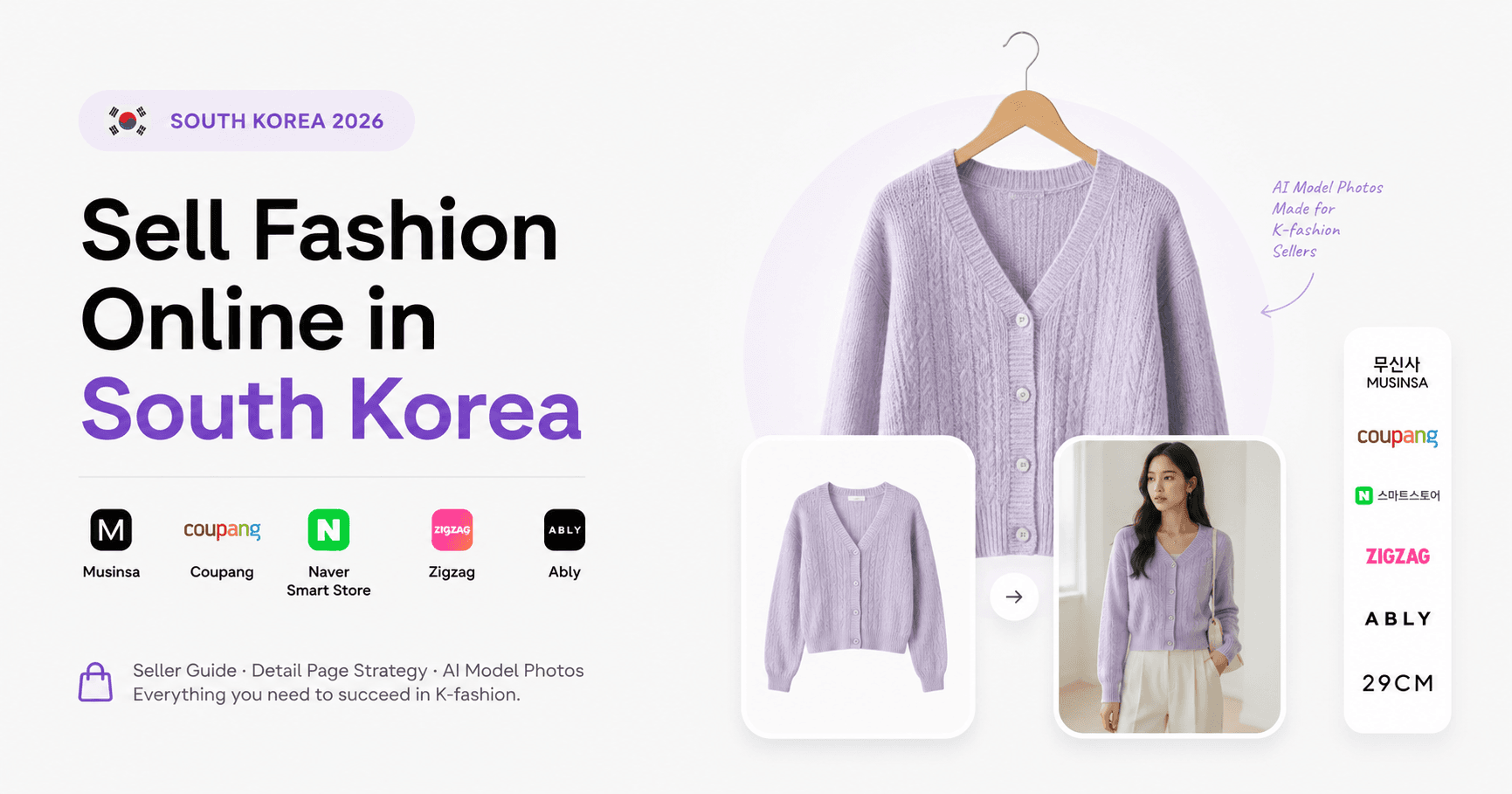
South Korea is the most visually demanding fashion ecommerce market on earth. Not the biggest — but the one where imagery does the most work, and where a seller with weak photos simply does not exist.
Here is why. Korean product pages do not look like Western ones. A Korean fashion listing is a 상세페이지 (sangse-peiji — "detail page"): a long, vertically scrolling, image-dominated experience that can run for dozens of screens. It contains the 누끼컷 (nukki-cut — the cut-out, white-background product shot), the 모델컷 (model-cut — the on-model photograph), the 착용샷 (chagyong-shot — the worn shot), fabric close-ups, styling suggestions, size charts rendered as images, and sometimes a full editorial narrative. The text is minimal. The images are the product page.
And 72% of Korean online sales happen on mobile — meaning that entire scroll happens on a phone, one thumb-flick at a time.
This is why K-fashion's visual standards are the highest in the world, and why Korean sellers spend disproportionately on photography compared to sellers anywhere else. It is also why the single biggest bottleneck for the thousands of small Korean sellers sourcing from 동대문 (Dongdaemun), Korea's vast wholesale fashion district, is not stock, pricing, or logistics. It is the photoshoot.
This guide covers the real 2026 landscape: Musinsa (무신사), Korea's number-one fashion platform; Coupang, the "Amazon of Korea"; Naver Smart Store (스마트스토어), where 70%+ of Korean search begins; Zigzag and Ably, the mobile-first apps where young Korean women actually shop; plus 29CM, W Concept, SSG.com and Gmarket. Registration, commissions, the legal requirements foreign sellers must clear, the 상세페이지 anatomy — and how AI model photography and short video ads let you meet Korea's visual bar without a Seoul studio.
FEATURED SNIPPET
How do you sell fashion online in South Korea?
South Korea's fashion ecommerce runs across several distinct platforms. Musinsa (무신사) is Korea's number-one fashion platform, curated and brand-focused, and the definitive destination for K-fashion, streetwear and designer labels. Coupang is the largest general marketplace (often called the "Amazon of Korea"), with over 18 million active customers and a market share commonly cited above 20%; its Global Seller Program lets international sellers list without a Korean legal entity, though with limitations. Naver Smart Store (스마트스토어) is essential because over 70% of Koreans search on Naver, making it the SEO-driven channel. Zigzag and Ably are the mobile-first apps where young Korean women shop, largely stocked by sellers sourcing from the 동대문 (Dongdaemun) wholesale district. Korean law requires a Mail Order Business Certificate (통신판매업 신고) and business registration; product notice information and detail-page text must be in Korean. Coupang commission commonly runs around 4–11% by category, with fashion typically around 10–11%. Critically, Korean listings are built around the 상세페이지 (detail page) — a long, image-dominated scrolling page requiring 누끼컷 (cut-out shots), 모델컷 (model shots) and 착용샷 (worn shots). Because imagery volume is the main bottleneck, AI model photography tools like Studiofy — generating photorealistic on-model images and 4, 6 and 8-second video ads from a single product photo — directly address Korean sellers' biggest production cost.
Studiofy At a Glance
Why South Korea Matters
One of the world's most advanced ecommerce markets — South Korea's ecommerce sector is projected around USD 82 billion in 2025, rising toward USD 93 billion by 2029, with user penetration climbing from roughly 67% to 77% and reaching around 37 million users. Over half of all retail transactions in Korea already happen online
Mobile-first to an extreme — Around 72% of Korean online sales occur on mobile. Your 상세페이지 is being read on a phone, in a vertical scroll. Design for that or lose
K-fashion is a global export — Korean street style, minimalist basics, and designer labels carry cultural weight far beyond Korea — amplified by K-pop, K-drama, and Korean creators. Musinsa has built global storefronts serving the US, Indonesia and other markets
Live commerce is mainstream — 라이브커머스 — real-time, video-driven selling via Naver Shopping Live and Kakao — is a genuine, established purchase channel in Korea, not an experiment. Video is not optional here
Cross-border interest is rising — Coupang and SSG.com run cross-border programs specifically to bring foreign brands to Korean shoppers
The honest counterpoint: Korea is hard. The Korean-language requirement is absolute. The legal setup — business registration, 통신판매업 신고, purchase safety certification — is genuinely bureaucratic. Delivery expectations (same-day and next-day) are punishing. The visual bar is the world's highest. And Korean shoppers are sophisticated, review-driven and unforgiving. Do not enter Korea casually.
The 상세페이지: Korea's Defining Feature
If you understand nothing else about Korean ecommerce, understand this.
A Western product page is: hero image, a gallery of five to nine photos, bullet points, a description. A Korean 상세페이지 is a long-form, image-dominated, vertically scrolling narrative — often the equivalent of a small magazine editorial for a single garment.
누끼컷 (nukki-cut) — the cut-out product shot on a clean white background. The technical, 'what is it' image. This is Korea's equivalent of the packshot
모델컷 (model-cut) — the on-model photograph. Multiple angles, multiple poses, often multiple models and multiple settings
착용샷 (chagyong-shot) — the 'worn shot,' showing the garment in real, natural wear — how it actually falls, moves, and sits on a body
디테일컷 (detail-cut) — fabric texture, stitching, hardware, trim, prints, in tight macro
Fabric and material information — often rendered as designed image panels rather than text
사이즈표 (size chart) — again, usually an image, frequently with model height/measurements (모델 착용 사이즈)
Styling and coordination suggestions — how to wear it with other items
Colour variants — shown individually, in full
The commercial implication is stark: a single Korean SKU can require ten, twenty, or more distinct images. Multiply that by a catalogue that refreshes weekly — as Korean fashion catalogues do — and you have the single largest, most punishing production cost in global ecommerce. This is the Korean seller's real bottleneck. Not sourcing. Not logistics. Photography volume.
The Dongdaemun (동대문) Reality
To understand the Korean fashion seller, understand 동대문.
Dongdaemun is Seoul's colossal wholesale fashion district — a dense ecosystem of wholesale markets where thousands of small online sellers 사입 (source/buy) their stock, often overnight, and list it online within days. It is the engine behind a huge share of the inventory on Zigzag, Ably, Naver Smart Store shops, and independent 쇼핑몰 (shopping malls).
These sellers move fast, carry many SKUs, and have thin margins. A seller might pick up thirty new styles in a week. And every one of those styles needs a full 상세페이지 — 누끼컷, 모델컷, 착용샷, 디테일컷.
Booking a model and a studio for thirty styles a week is, for most of these sellers, simply impossible. So they compromise: they use the wholesaler's supplied photos (which every competing seller also uses, destroying differentiation), or they shoot flat lays that convert poorly against competitors' model shots, or they skip styles entirely.
This is the single largest, most acute product-market fit for AI model photography anywhere in the world. A Dongdaemun-sourcing seller who can turn a single flat product photo into a full set of 모델컷 and 착용샷 — for every style, the same day — is competing on an entirely different level.
The Korean Marketplace Landscape
Musinsa (무신사) — Korea's #1 fashion platform
Musinsa began in the early 2000s as an online sneaker community where people shared outfit photos — and grew into the definitive Korean fashion platform. Today it is where K-fashion lives: streetwear, minimalist basics, sneakers, designer labels, and the trend-setting brands seen in K-dramas and on K-pop stages. It also runs its own labels (Musinsa Standard) and has expanded internationally through Musinsa Global.
For a fashion brand, Musinsa is the prize. It is curated, brand-focused (입점 — "entering" Musinsa — is a genuine milestone for a Korean label), and its audience is the most fashion-literate in the country. Its visual standards are correspondingly uncompromising — Musinsa's community DNA means its users have been evaluating outfit photography for two decades.
Practical note: Musinsa's onboarding (입점) is curated and brand-oriented rather than open self-serve. Requirements evolve — apply through Musinsa's official partner/입점 channels and confirm current criteria directly.
Coupang — the "Amazon of Korea"
Launched 2010, NYSE-listed in 2021, with over 18 million active customers, 66,000+ employees, and a market share commonly cited above 20%. Its Rocket Delivery logistics is legendary and central to its dominance.
Commission — varies by category — commonly cited from around 4% (jewellery) to about 10–11% for fashion, with electronics around 5–8%. Confirm your exact category rate
Global Seller Program — lets international sellers list without establishing a Korean legal entity — a genuinely valuable route. But note the limitation: global sellers generally cannot set a Korean local warehouse as their shipping origin (only the return centre can be local), which materially affects delivery speed in a market obsessed with it
Images — Coupang allows one representative (hero) image plus up to nine additional images, with the Detailed Description (상세페이지) below — and its text must be in Korean
Korean law — product notice information (상품정보제공고시) is mandatory and must be in Korean
Watch out — if your registered category does not match the product, Coupang removes it — and you cannot re-list it; you must register the product again
Coupang enforces an original-content IPR policy — you may not use other sellers' or creators' images without permission. Relevant to Dongdaemun sellers relying on wholesaler photos
Naver Smart Store (스마트스토어) — the SEO channel
Over 70% of Koreans search on Naver, not Google. Naver Shopping holds a market share commonly cited around 17%, and Naver Smart Store is how you get into it. This makes Naver Korea's organic-visibility channel — the equivalent of ranking on Google in the West. If you want durable, search-driven discovery in Korea, Naver Smart Store is not optional. It also powers Naver Shopping Live, Korea's dominant live-commerce platform.
Zigzag and Ably — where young Korean women actually shop
Mobile-first fashion apps with enormous traction among young Korean women, largely stocked by 동대문-sourcing sellers and independent 쇼핑몰. Fast-moving, trend-driven, intensely visual, and algorithmically curated. If your target is Korean women aged roughly 18–34, these matter enormously.
29CM and W Concept — the premium curators
Design-led, editorially curated platforms for premium and designer brands. Exceptionally high visual and brand standards. 29CM in particular is known for treating product pages as editorial content.
SSG.com, Gmarket, 11st, Auction
SSG.com (Shinsegae Group) targets premium and luxury — designer fashion, high-end cosmetics — with an affluent audience and integration into Shinsegae Department Store and Emart. Gmarket, 11st, and Auction are established general marketplaces.
Cafe24, Shopify, Kakao
Cafe24 is Korea's dominant D2C store platform (the Korean equivalent of Shopify) and powers a huge number of independent 쇼핑몰. Kakao offers shopping and live commerce through Korea's dominant messaging app.
Korean Marketplace Comparison
Legal and Regulatory Requirements
Korea is bureaucratic, and the requirements are real. This guide is not legal or tax advice — get professional counsel before entering the Korean market.
Business registration (사업자등록증) — Required to sell. Foreign sellers wanting a full local seller account generally need to establish a Korean legal entity, though Coupang's Global Seller Program offers a route around this with limitations
Mail Order Business Certificate (통신판매업 신고) — Mandatory under Korean law before listing products. Filed at the local municipal office; processing commonly takes around 5–7 business days
Purchase Safety Service Certificate — Mandated by Korean law for secure ecommerce transactions — requires business registration details and proof of corporate bank account ownership
Product notice information (상품정보제공고시) — Mandatory, category-specific, and must be in Korean. This is a legal requirement, not a marketplace preference
Korean corporate bank account — and regular VAT and income tax filing
Practical route for foreign sellers: either (a) use Coupang's Global Seller Program and accept its shipping-origin limitation, (b) incorporate a Korean entity (commonly reported to take around 2–4 weeks with professional help, and possible remotely), or (c) work with a Korean distributor or agency.
Localisation: You Must Speak Korean
Non-negotiable. Detail-page text and product notice information must be in Korean by law, not merely by convention.
But note a useful Korean nuance: Korean shoppers frequently search using English brand names alongside Korean terms. Effective Korean listings often use bilingual keywords — English brand and product names combined with Korean descriptive terms.
The vocabulary that matters for a Korean fashion catalogue:
Categories: 여성의류 (women's clothing) · 남성의류 (men's clothing) · 아동복 (kidswear) · 원피스 (dress) · 상의 (tops) · 하의 (bottoms) · 아우터 (outerwear) · 니트 (knitwear) · 셔츠 (shirts) · 티셔츠 (t-shirts) · 블라우스 (blouse) · 청바지 (jeans) · 바지 (trousers) · 스커트 / 치마 (skirt) · 자켓 (jacket) · 코트 (coat) · 신발 (shoes) · 가방 (bags) · 액세서리 (accessories) · 빅사이즈 (plus size)
Photography terms: 상세페이지 (detail page) · 누끼컷 (cut-out shot) · 모델컷 (model shot) · 착용샷 (worn shot) · 디테일컷 (detail shot) · 룩북 (lookbook) · 화보 (editorial) · 상품 이미지 (product image) · 제품사진 (product photo) · 사이즈표 (size chart) · 모델 착용 사이즈 (model's worn size)
Business terms: 입점 (entering/onboarding a platform) · 판매자 / 셀러 (seller) · 쇼핑몰 (online shop) · 사입 (wholesale sourcing) · 동대문 (Dongdaemun) · 스마트스토어 (Smart Store) · 사업자등록증 (business registration) · 통신판매업 신고 (mail order business filing) · 라이브커머스 (live commerce) · AI 모델 (AI model)
How Studiofy Helps Korean Fashion Sellers
Look honestly at what Korea demands:
A 상세페이지 requiring ten to twenty-plus images per SKU — 누끼컷, 모델컷, 착용샷, 디테일컷
A catalogue that refreshes weekly — especially for 동대문-sourcing sellers
The world's highest visual standards — set by Musinsa's two-decade-old outfit-photography culture
72% mobile — meaning that entire image-heavy scroll happens on a phone
라이브커머스 and short-form video — as mainstream purchase channels
Coupang's original-content IPR policy — meaning wholesaler-supplied photos that every competitor also uses are both a differentiation failure and a potential compliance risk
The maths simply does not work with traditional photography. A Seoul studio shoot per style, thirty styles a week, is not a business — it is a bonfire.
Photograph your garment cleanly, or use your 누끼컷
A flat lay, hanger shot, or existing cut-out product photo is a valid input. Our lighting guide and flat lay guide cover the input side.
Upload to Studiofy and choose your model and setting
Select model appearance, pose, and setting appropriate to your brand and the Korean aesthetic — a Musinsa streetwear label and an Ably women's 쇼핑몰 want very different looks.
Generate your 모델컷 and 착용샷
Photorealistic on-model images from your real garment, preserving its actual colour, print, and texture — multiple poses and settings, the same day, at 상세페이지 volume.
Generate short video for 라이브커머스 promotion, Instagram, TikTok and Reels
From the same product image, Studiofy produces 4-second, 6-second, and 8-second product videos. In a market where live commerce and short-form video are mainstream purchase channels, this is core, not optional.
Build the full 상세페이지 and verify
Combine 누끼컷 (white background), 모델컷, 착용샷, and 디테일컷 into your vertical detail page — and check colour accuracy against the physical garment before publishing.
An honest note on AI imagery and Korean compliance. No major marketplace, Korean or otherwise, has issued a blanket ban on AI-generated imagery as of 2026. What every platform applies — equally to AI images and photographs — is its existing accuracy standard. The image must faithfully represent the actual garment, and every specification still applies. Coupang's IPR policy additionally requires original content — which is precisely why AI-generated imagery of your own product is a stronger position than reusing a wholesaler's photos that fifty competing sellers are also using. Korean shoppers are exceptionally review-driven and unforgiving of misrepresentation, so imagery that flatters a garment beyond reality is commercially suicidal here. Verify current policy with each platform, and use AI the way Studiofy is designed to be used: to show your real product, accurately, on a model.
Priority Korean Fashion Categories
여성의류 (Women's Fashion) — the largest opportunity. 원피스 (dresses), 블라우스, 니트, 스커트, 아우터. The core of Zigzag, Ably, and 동대문-sourced 쇼핑몰
남성의류 (Men's Fashion) — Musinsa's historical stronghold. Streetwear, minimalist basics, 셔츠, 니트, 아우터
신발 (Footwear) — sneakers are foundational to Musinsa's identity. See our footwear photography guide
가방 & 액세서리 — see our handbag photography guide
Athleisure / 스포츠웨어 — see our activewear photography guide
Streetwear — Korea's global cultural export
빅사이즈 (Plus size) — under-served and growing
K-Beauty adjacency — Korean beauty and fashion audiences overlap heavily; Olive Young dominates beauty retail
Common Mistakes Selling Fashion in Korea
Building a Western-style product page — Korean buyers expect a 상세페이지. A five-image gallery and bullet points will not convert.
Using wholesaler-supplied photos — Every competing 동대문 seller has the identical images. You have no differentiation — and Coupang's IPR policy expects original content.
Skipping 모델컷 and 착용샷 — Korean shoppers evaluate fit and drape obsessively. Product-only images lose.
Machine-translated Korean — Korean shoppers detect it instantly. Product notice information must be in Korean by law — and it must be correct.
Ignoring Naver — Over 70% of Korean search happens on Naver, not Google. Skipping Naver Smart Store means skipping organic discovery.
Designing for desktop — 72% of sales are mobile. Your 상세페이지 is a thumb-scroll.
Mis-categorising on Coupang — A category mismatch means removal — and you cannot re-list; you must register the product again.
Ignoring live commerce and video — 라이브커머스 is a mainstream purchase channel in Korea, not a novelty.
Underestimating the legal setup — 통신판매업 신고 is mandatory. Purchase Safety certification is mandatory. Get professional help.
Frequently Asked Questions
The World's Highest Visual Bar — Cleared From Your Phone
No market on earth asks more of your photographs than Korea. A 상세페이지 that runs for twenty screens. 누끼컷, 모델컷, 착용샷, 디테일컷 — for every colourway, of every style, in a catalogue that turns over weekly. A mobile-first audience trained by two decades of Musinsa outfit photography to judge instantly. And live commerce running in the background, demanding video too.
For a 동대문-sourcing seller with thirty new styles this week, that is not a photography brief. It is an impossibility.
Unless the studio is in your pocket.
Studiofy turns a single product photo into the 모델컷 and 착용샷 a Korean 상세페이지 demands — your real garment, its real colour and texture, on a photorealistic model, in multiple poses and settings, the same day. Plus 4-, 6-, and 8-second video ads for 라이브커머스 promotion, Instagram, and TikTok.
No Seoul studio. No model booking. No wholesaler's photos that fifty competitors are already using.
Upload your product. Generate your 모델컷. Build the 상세페이지 that sells.
Look Like a Brand.
Start creating Korean marketplace-ready AI model images and video ads today.