How to Start a Fashion Brand Online in 2026: The Complete Step-by-Step Guide
Millions of people search for how to start a fashion brand every month. Most of them never do.
Not because the idea is wrong. Not because the market is too crowded. Not because starting a fashion brand is harder than it looks — though it is. Most of them stop because the first step they actually take — trying to figure out how to make their products look good enough to sell — exposes a cost they were not prepared for.
Professional model photography. A studio. A photographer. A model. A styling team. Editing. And a three-week wait before they have a single image they can publish.
That gap — between having a product and being able to present it professionally — has stopped more fashion brands before they started than any other single obstacle. In 2026, that gap no longer needs to stop you.
This guide covers every step of starting a fashion brand online — from finding your niche to making your first sale — with a direct and practical focus on what actually determines whether a new fashion brand succeeds. Written for founders in Mumbai and Delhi, London and Manchester, New York and Los Angeles, Seoul and São Paulo, Lagos and Istanbul, and every city in between where someone is sitting on a product idea that deserves to become a brand.
FEATURED SNIPPET
How do you start a fashion brand online in 2026?
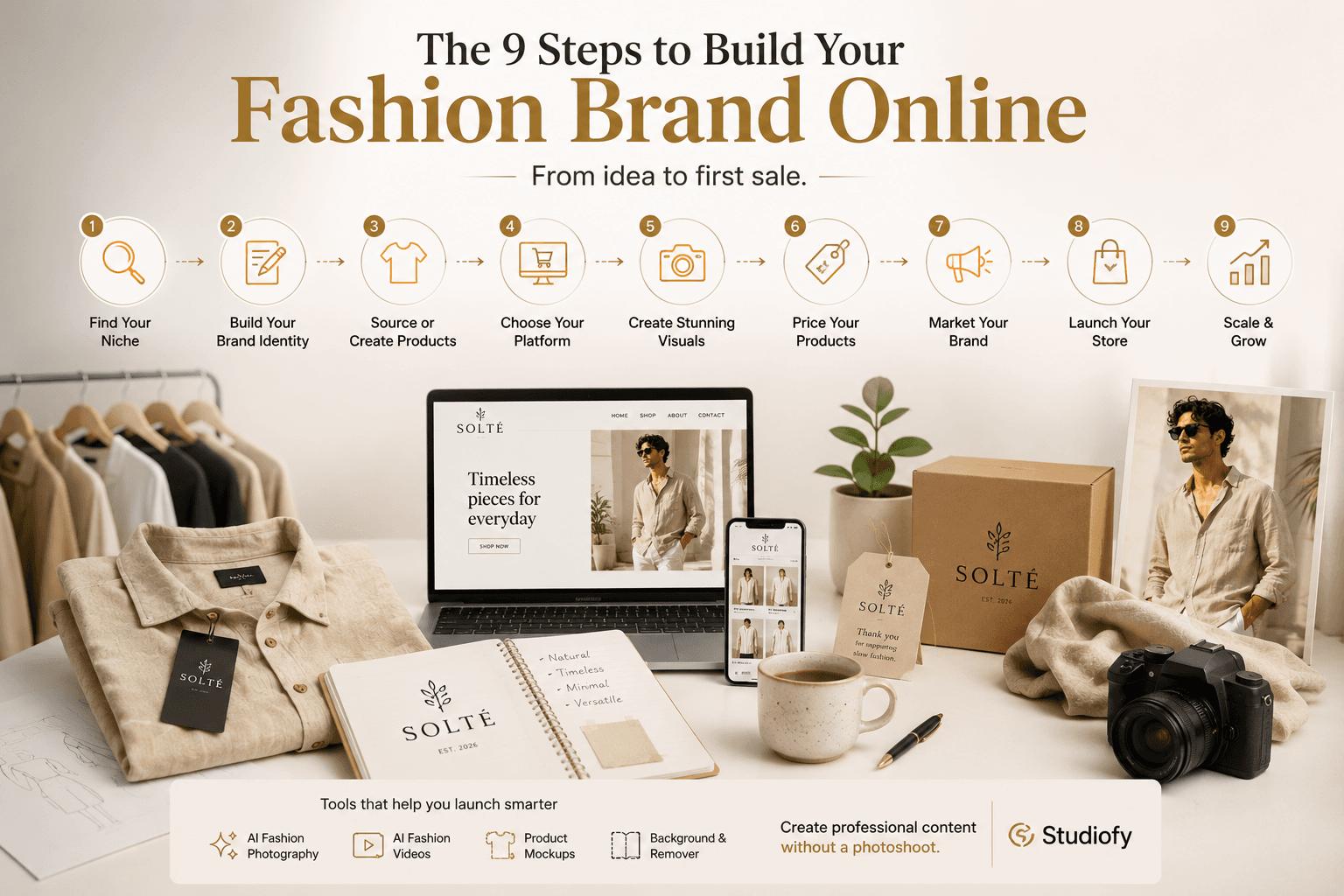
To start a fashion brand online in 2026: define your niche and target customer, build your brand identity, source or manufacture your products, choose your selling platform (Shopify, Amazon, Etsy, Instagram, or a combination), create professional product photography and video content using AI fashion photography tools, set your pricing, launch with a focused marketing strategy, and expand to additional marketplaces. The most critical step is professional visual content — brands with model photography convert up to 3x better than those without.
Studiofy At a Glance
Why 2026 Is One of the Best Times to Start a Fashion Brand Online
Before the steps, the context. Because the opportunity for new fashion brands has never been better structured — and understanding why helps you build for it.
Global fashion ecommerce is projected to exceed $1.2 trillion in annual revenue by 2027. The market is not consolidating into fewer, larger brands. It is fragmenting — into thousands of niche brands that serve specific aesthetics, communities, values, and lifestyles more precisely than mass-market fashion can.
This fragmentation is driven by platforms that have democratised both distribution and discovery:
Shopify — has over 4 million active stores. A founder in Bengaluru, Lagos, Warsaw, or Melbourne can build and launch a branded ecommerce store in days, selling globally from day one.
Instagram and TikTok — have made it possible for a fashion brand with zero advertising budget to reach millions of buyers through organic content — if the visual content is compelling enough.
Amazon, Flipkart, Meesho, Etsy, Zalando, Trendyol, Shopee, and Mercado Libre — give new brands immediate access to massive, transaction-ready buyer audiences without having to build traffic from scratch.
AI tools — for product photography, video generation, design, copywriting, and customer service — have eliminated the need for large teams at the early stages of a fashion brand.
The result: a solo founder with a great product, a smartphone, and the right tools can now build a fashion brand that competes visually and commercially with established players — from their bedroom, their workshop, or their factory floor.
Step 1: Define Your Fashion Niche
The most common mistake new fashion founders make is trying to be everything to everyone. "Women's clothing" is not a niche. "Sustainable Indian ethnic wear for urban professional women aged 25–38" is a niche. The specificity feels limiting. In practice, it is what makes a brand discoverable, memorable, and loyal.
How to Find Your Fashion Niche
Start with what you know. The best fashion niches are founded by people who are deeply embedded in a specific community, aesthetic, or lifestyle. A founder who grew up in Surat surrounded by textile manufacturing has an authentic relationship with fabric quality and ethnic design. A founder in London's streetwear culture has an authentic relationship with the visual language of that community. Authenticity in fashion niche selection is not a soft concept — it drives product credibility, content authenticity, and community trust.
Look for the underserved gap. The most commercially successful fashion niches are not the most popular ones — they are the ones where a clear, underserved demand exists. Modest fashion for South Asian women in Western markets. Plus-size streetwear. Sustainable kidswear. Men's ethnic wear for millennials. Gender-neutral fashion for Gen Z. Identify who is being poorly served by existing brands and whether you can serve them better.
Check search and social signals. Before committing to a niche, validate it. Search your niche keyword on Google and see what comes up. Browse Instagram hashtags for your niche aesthetic. Check Etsy and Amazon for product category search volume. If buyers are already searching and buying in your niche, demand exists. If the search results are thin and the Instagram hashtags are small, you may be ahead of the market — or ahead of where the market will go.
Fashion Niche Examples by Market
Step 2: Build Your Brand Identity
Your niche tells you who you are serving. Your brand identity tells them who you are. These are two different things, and both matter from day one.
The Elements of a Fashion Brand Identity
Brand name — Short, memorable, pronounceable in your target markets, and available as a domain and social handle. Check trademark availability before committing. Your brand name is the foundation of every other brand asset you will build.
Brand positioning statement — A one-sentence articulation of what your brand is, who it is for, and what makes it different. This is not your marketing tagline — it is your internal compass for every creative and business decision.
Visual identity — Colour palette, typography, logo, and the overall aesthetic vocabulary of your brand. For a fashion brand, visual identity is not a logo exercise — it is the entire visual language your products, photography, social media, and packaging communicate. Consistency in visual identity is what makes a fashion brand feel premium rather than improvised.
Brand voice — How your brand communicates in writing — across product descriptions, social media, email, and advertising. A luxury fashion brand and a streetwear brand targeting Gen Z should sound completely different, even if both are selling comparable products.
Target customer profile — A specific, detailed description of who your ideal customer is. Not a demographic summary — a real person. Where do they live? What do they care about? Where do they shop? What do they aspire to? What brands do they already buy?
Step 3: Source or Manufacture Your Products
Fashion brands source their products in one of three ways. Understanding the options helps you choose the model that fits your capital, timeline, and growth ambition.
Option 1: Manufacture Your Own Products
You design the product, source materials, and work with a manufacturer or produce in-house. This gives you maximum control over quality, design uniqueness, and profit margin — but requires the most capital, lead time, and supply chain management.
Where to find manufacturers: India — IndiaMART, TradeIndia, direct outreach to clusters in Surat (textiles), Tiruppur (knitwear), Jaipur (ethnic wear, block print), Ludhiana (woollens), Ahmedabad (denim, cotton). International — Alibaba, Global Sources, direct factory sourcing in Bangladesh, Vietnam, Turkey, Portugal. Domestic alternatives — local garment manufacturers in your city, small-batch production specialists, print-on-demand platforms for low-minimum launches.
Option 2: Private Label
You source blank or existing products from a manufacturer and brand them as your own — with your labels, packaging, and visual identity. Lower design complexity than full manufacturing, but gives you a branded product without starting from scratch. Private label is the model used by a large proportion of Amazon FBA sellers, Shopify stores, and Instagram fashion brands that launch and scale quickly.
Option 3: Dropshipping or Print-on-Demand
You sell products you do not physically hold — the supplier ships directly to the buyer when an order is placed. Zero inventory risk, but lower margins and less control over product quality and delivery experience. Print-on-demand is particularly popular for branded apparel and accessories sold on Etsy, Shopify, and emerging creator commerce platforms.
Step 4: Choose Your Selling Platform — or Combination
One of the most consequential early decisions for a new fashion brand is where to sell. The right answer in 2026 is almost always a combination — but the combination should be built strategically, not scattered.
Platform Options for New Fashion Brands
Shopify (D2C website) — The gold standard for building a branded fashion ecommerce store. Gives you complete control over brand experience, customer data, and margin. Requires you to drive your own traffic. Ideal as a primary brand home, built alongside marketplace presence.
Instagram and TikTok Shop (Social Commerce) — The fastest way to reach buyers who do not know your brand exists yet. Organic content drives discovery; TikTok Shop and Instagram Shopping integrations enable direct purchase. Essential for fashion brands in 2026 — social commerce is not a side channel anymore.
Amazon (India, US, UK, Germany, UAE) — Immediate access to enormous, transaction-ready buyer audiences. Competitive in fashion categories. Requires strong product photography and listing optimisation to stand out. The fastest path to volume for many new fashion brands.
Flipkart and Meesho (India) — The dominant marketplaces for fashion in India. Meesho in particular has enormous reach in Tier 2 and Tier 3 Indian cities — a critical market for ethnic wear, casual fashion, and value-segment brands.
Etsy (Global) — The leading platform for handmade, boutique, and independent fashion. Particularly strong for jewellery, accessories, artisan fashion, and unique apparel. International buyer base with high willingness to pay for craft and uniqueness.
Zalando (Europe) — Europe's leading fashion marketplace — covering Germany, France, Netherlands, Belgium, Poland, and other European countries. Getting listed on Zalando is a credibility signal as much as a distribution channel.
Shopee and Lazada (Southeast Asia) — The dominant ecommerce platforms across Vietnam, Indonesia, Thailand, Malaysia, the Philippines, and Singapore. Growing fashion categories across all markets.
Mercado Libre (Latin America) — The dominant ecommerce platform across Brazil, Argentina, Colombia, Chile, and Mexico. Essential for fashion brands targeting Latin American markets.
Platform Strategy for New Fashion Brand Founders
Phase 1 — Launch
Start with 1–2 platforms maximum. Most new fashion brands start with Instagram + Shopify or Instagram + Meesho/Amazon India, depending on their target market. Building simultaneously across five platforms from day one spreads attention and budget too thin.
Phase 2 — Scale
Once your core platform is generating consistent revenue and you have operational capacity, expand to additional marketplaces. Amazon, Flipkart, Etsy, and Zalando are natural scale platforms depending on your category and target geography.
Phase 3 — Global
With proven product-market fit and sufficient inventory, expand internationally — using platform localisation features (Amazon global selling, Shopify international markets, Etsy's global shipping) to reach buyers in new geographies.
Step 5: Build Your Visual Identity — Photography and Video
This is the step where most new fashion brands make their most expensive mistake. And it is the step that determines more of your brand's commercial success than almost anything else.
Your products will be judged by their images before they are judged by anything else. Every platform buyer, every Instagram follower, every TikTok viewer makes an immediate visual judgment. If your product presentation looks cheap, unpolished, or amateurish — regardless of the actual quality of the product — the buyer's trust does not form. The visual gap between "home seller" and "brand" is almost entirely a photography gap.
Why Fashion Brand Photography Is the Highest-Leverage Investment
The Traditional Photography Problem for New Fashion Brands
A professional fashion photoshoot — model, photographer, studio, makeup artist, stylist, and post-production — costs:
India — ₹38,000 to ₹2,10,000 per session (covering 15–30 products)
United Kingdom / Europe — £1,000 to £8,000 per session
United States — $1,500 to $9,000+ per session
For a new fashion brand that has just spent its capital on inventory, this is either impossible or dangerously expensive. And it needs to be repeated for every new collection, every seasonal refresh, and every new product launch.
Most new fashion founders solve this badly — with flat lays shot on their bedroom floor or hanger shots under poor lighting — and then wonder why their conversion rate is low. The product is good. The images are not doing it justice.
The 2026 Solution: AI Fashion Photography
AI fashion photography has fundamentally changed the economics and accessibility of professional fashion brand imagery. Platforms like Studiofy generate photorealistic model photography from a single product photo — in seconds, on a smartphone, at a fraction of the cost of a traditional shoot.
Upload your product image
A flat lay, hanger shot, or plain-background smartphone photo. No DSLR, no studio lighting, no professional setup required.
Select your AI model preferences
Choose model appearance, pose, background, and lighting style. Align with your brand aesthetic and target customer — whether that is an urban streetwear aesthetic, a luxury jewellery presentation, a modest fashion context, or a contemporary ethnic wear setting.
Generate
Studiofy's AI produces a photorealistic model image in seconds. The platform understands fabric, drape, fit, and how light interacts with different materials — producing images that look like they were taken in a professional studio.
Download and publish
High-resolution output ready for your Shopify store, Amazon listing, Flipkart catalog, Instagram feed, TikTok content, or Meta ad creative.
AI Fashion Video for New Fashion Brands
Studiofy's expanded capability now includes AI fashion video — generating short-form video content and product videos from your product image. For fashion brands launching in 2026, video is as important as photography. TikTok and Instagram Reels are the primary discovery channels for new fashion brands. Amazon product listing videos improve conversion rates significantly. AI fashion video allows new brand founders to produce TikTok content, Instagram Reels, product page videos, and UGC-style ad creative — without a video production team or shoot budget.
Photography Standards by Platform for New Fashion Brands
Step 6: Price Your Fashion Products Correctly
Pricing a fashion brand correctly is one of the most common areas where new founders either leave money on the table or price themselves out of the market.
The Fashion Brand Pricing Formula
Cost of Goods (COG) — Manufacturing cost + materials + labels + packaging + shipping to warehouse.
Gross Margin Target — Fashion brands typically target 60–80% gross margin on DTC sales. This means if your COG is ₹300 or $5, your selling price should be ₹750–₹1,500 or $12–$25+.
Platform and Payment Fees — Shopify, Amazon, Flipkart, and Etsy each charge a percentage of each sale. Factor these into your net margin calculation per channel.
Customer Acquisition Cost (CAC) — How much does it cost to acquire each customer through advertising, influencer partnerships, or other marketing? Your gross margin must comfortably absorb your CAC and still leave net profitability.
Competitive Positioning — For premium and luxury positioning, pricing too low undermines brand credibility. For value positioning, pricing too high removes the core competitive advantage.
The Price Anchoring Mistake: Many new fashion brands price too low in an attempt to compete on price — and then cannot sustain marketing investment, cannot afford quality photography, and cannot generate the margin needed to reinvest in growth. Competing on price is the most difficult and least defensible strategy in fashion ecommerce. Competing on visual presentation, brand identity, community, and product quality — while pricing for healthy margins — is the strategy that builds durable brands.
Step 7: Launch Your Fashion Brand
A great product, a professional visual identity, and a well-set-up platform mean nothing without a launch strategy that drives initial traffic and first sales.
Pre-Launch: Build Before You Sell
Start your Instagram and TikTok presence before you launch — Post behind-the-scenes content, product previews, brand story content, and the visual aesthetic of your brand before your first product goes live. Build an audience of people who are primed to buy when you open.
Build an email list — Run a pre-launch 'notify me' campaign on your Shopify store or via a landing page. A list of 500 engaged subscribers who have opted in to hear about your launch is more valuable than 50,000 cold impressions on your launch day.
Reach out to micro-influencers in your niche — Fashion micro-influencers (5,000–100,000 followers) in your specific niche often have higher engagement rates and more targeted audiences than macro-influencers. A product collaboration or gifting arrangement with 5–10 well-chosen micro-influencers can generate the kind of authentic social proof that a new brand needs.
Prepare your content library — Your launch week needs enough visual content to post daily across platforms. AI fashion photography and video allows you to generate this content library before launch day — so you are not scrambling to produce content while simultaneously managing orders and customer service.
Launch Week Strategy
Day 1 — Launch announcement across all platforms simultaneously. Email to your pre-launch list. Instagram and TikTok Reels of your product in motion.
Days 2–7 — Daily content across Instagram and TikTok — product features, styling ideas, brand story, and founder content. Engage every comment and DM.
First 30 days — Focus entirely on your core platform. Do not spread to new channels yet. Learn from your initial buyer data — who bought, what they bought, where they came from, and what they said about the product.
Step 8: Market Your Fashion Brand Online
Getting your first sales is one milestone. Building a repeatable, scalable marketing engine is the next one. These are the channels that drive consistent fashion brand growth in 2026.
Organic Social Media (Instagram and TikTok)
Organic social is the primary acquisition channel for new fashion brands with limited advertising budgets. The strategy that works: post 5–7 times per week on TikTok and 4–6 times per week on Instagram (Reels primarily). Mix of product showcase content (AI model videos and photos), styling inspiration, and brand story. Consistent visual aesthetic — every post should look like it belongs to the same brand. Engage authentically with comments, DMs, and community conversations.
AI fashion photography and video is the content production engine that makes this posting frequency sustainable for a small team or solo founder.
Paid Advertising (Meta Ads and TikTok Ads)
Once you have enough data from organic content to know which products and creative approaches resonate with your audience, paid advertising accelerates growth. Start with retargeting (showing ads to people who have visited your site or engaged with your content) before investing in cold-audience prospecting. Creative is everything in fashion advertising. The biggest lever on ad performance is not budget or targeting — it is the quality and relevance of the creative. AI fashion model images and video creative give new brands the ability to test multiple creative variations without multiple photoshoots.
Search Engine Optimisation (SEO)
Every major fashion brand website should invest in SEO from day one. Your blog, product descriptions, category pages, and brand story pages are all opportunities to rank for the keywords your target customers are searching. Focus on product category keywords ("sustainable women's kurtas", "premium leather handbags India", "streetwear hoodies UK"), informational keywords related to your niche, and long-tail buyer intent keywords that convert directly to purchases.
Email Marketing and Retention
A buyer who purchases once is worth far less than one who purchases three times. Email marketing — welcome sequences, product launch announcements, abandoned cart flows, and loyalty campaigns — is the channel that turns first-time buyers into repeat customers. For fashion brands, a 20–30% repeat purchase rate within 90 days is achievable with a well-structured email retention programme.
Influencer and Creator Partnerships
Fashion brands grow through community and visual storytelling. Influencer partnerships — particularly with niche micro-influencers who have highly engaged, relevant audiences — generate the social proof and authentic visual content that drives buyer trust. In India, look for fashion content creators with audiences in your target city tier and niche aesthetic alignment. In the UK, US, and European markets, look for creators whose aesthetic matches your brand's visual identity rather than those with the largest follower counts.
Step 9: Scale — Marketplace Expansion and Global Reach
Once your core channel is profitable and your operations are stable, marketplace expansion is the most efficient path to revenue growth for a fashion brand.
India: Flipkart, Meesho, Myntra, Ajio, Nykaa
India's fashion marketplace ecosystem is one of the largest and fastest-growing in the world. For fashion brands already selling on Amazon India or their own Shopify store, expanding to Flipkart, Meesho, or Myntra brings immediate access to tens of millions of additional buyers. Meesho is particularly valuable for reaching Tier 2 and Tier 3 cities — markets that are underserved by premium brands but have rapidly growing disposable income and fashion awareness.
Europe: Zalando, ASOS Marketplace, Not On The High Street
Zalando is Europe's dominant fashion marketplace — covering Germany, France, Netherlands, Belgium, Poland, and 15+ other European countries. Getting listed on Zalando is a credibility signal as much as a distribution channel. ASOS Marketplace is the equivalent for independent and boutique UK fashion brands. Not On The High Street serves independent UK brands with a design-conscious, higher-income buyer base.
Global: Amazon International Selling, Etsy Global
Amazon's global selling programme allows fashion brands to list on Amazon US, Amazon UK, Amazon Germany, Amazon France, Amazon UAE, and Amazon Japan from a single seller account. Etsy's international shipping enables fashion creators to sell to buyers in 200+ countries from a single shop.
Southeast Asia: Shopee and Lazada
For fashion brands with aspirations to reach Southeast Asian buyers — across Vietnam, Indonesia, Thailand, Malaysia, Singapore, and the Philippines — Shopee and Lazada are the essential platforms. Both have massive fashion categories and active buyer bases that are growing rapidly.
Middle East: Noon, Namshi, Amazon.ae
The UAE, Saudi Arabia, and broader MENA market represent one of the highest per-capita fashion spend markets in the world. Noon and Amazon.ae are the primary ecommerce channels, with Namshi the dominant fashion-specific platform.
The Visual Consistency Advantage at Scale
As your fashion brand grows from one platform to three, from ten products to a hundred, and from one market to five — visual consistency becomes the brand asset that compounds.
Every product photographed in a consistent style, on consistent AI model presentations, with consistent background and lighting — accumulates into a catalog that looks like a real, established brand. Buyers browsing your Amazon listing, your Shopify store, and your Instagram in the same session should feel a coherent visual identity across all three.
Studiofy's AI fashion photography and video generation maintains this consistency at scale — because every image is generated through the same platform, with the same model preferences and visual standards, regardless of how many products you are adding to your catalog or how many channels you are publishing to.
Common Mistakes When Starting a Fashion Brand Online
Launching before your visual content is ready — The most common mistake is going live with flat, unpolished product images because 'good enough' feels faster than waiting for professional photography. It is not faster. Poor images deliver poor conversion rates and poor first impressions that are extremely difficult to recover from.
Choosing a niche that is too broad — 'Women's fashion' is a market. 'Contemporary modest fashion for South Asian women in Western markets' is a niche. The broader the niche, the harder the discovery and the weaker the community.
Underinvesting in marketing before launch — Products do not sell themselves, even good ones. Budget for content production, influencer partnerships, and initial paid advertising from the start — not as an afterthought once inventory is sold and cash is tight.
Building on one channel only — Over-reliance on a single platform — whether it is Instagram, Amazon, or a Shopify store — makes your brand structurally vulnerable. Platform algorithm changes, marketplace policy updates, or account suspensions can eliminate your revenue overnight.
Skipping brand identity and going straight to product — A product without a brand is a commodity. A product with a strong brand identity, visual language, and community connection commands premium pricing and generates customer loyalty. Brand investment at the start pays compounding dividends at scale.
Not testing multiple visual creative approaches — AI fashion photography allows new brands to generate multiple model images and video variations per product at low cost. Use this to test which visual approach — which model type, which background, which pose — drives the highest click-through and conversion rate.
Pricing too low — Low prices signal low quality in fashion. Set your prices for the margins you need to market, reinvest, and grow — not for the price you think will guarantee your first sale.
Frequently Asked Questions
Your Fashion Brand Starts With a Decision
Every successful fashion brand — from independent Indian ethnic wear labels in Jaipur to streetwear brands in London and Seoul, from handmade jewellery sellers on Etsy in Dublin to D2C activewear brands on Shopify in New York — started with a founder who decided to begin.
The infrastructure to build a fashion brand online has never been more accessible. The platforms exist. The tools exist. The global buyer audience exists.
What used to cost ₹5,00,000 and three months to produce — professional model photography that makes a brand look credible — now takes seconds, on a phone, with Studiofy. The gap between a product and a brand is smaller than it has ever been. It is now mostly a decision.